
Board of Supervisors December 9th Cannabis vote
December 11, 2025

December 11, 2025 Newsletter
Recap of Board of Supervisors Dec 9th Cannabis program update
Thank you to everyone who showed up for the December 9th Cannabis Update hearing. Neighbors were strongly represented, and speaker after speaker made thoughtful, compelling arguments. In contrast, the cannabis industry offered just one public commenter — Eric Pearson (SPARC) — yet that was evidently enough for four supervisors (Coursey, Hopkins, Hermosillo, and Gore) to dismiss the concerns of their own constituents.
Supervisor Rabbitt delivered a clear, principled explanation of his position and cast the only “no” vote. Supervisor Gore participated via Zoom, but his connection was so poor that he was largely unintelligible. Chair Hopkins stepped in to “translate” and advance the proposal, including Gore’s last-minute addition of a 500-foot setback to agricultural parcels — a move seemingly intended to appease the Farm Bureau and wine industry. The Board adopted it with almost no discussion. Supervisor Coursey briefly noted that “human beings should be considered as well as grapes.” Supervisor Hermosillo offered no comment at all.
Several attendees observed Pearson and Permit Sonoma’s Scott Orr leave together during the break, deep in conversation — a discouraging visual considering the direction of the vote.
We showed up. We made our case clearly and respectfully. We looked our elected officials in the eye — and they disregarded and disrespected us.
The Press Democrat coverage (below) captures the broad strokes of the hearing, but it omits one important fact: the meeting was not properly noticed, continuing a troubling pattern of the County being careless with remote-participation posting requirements despite prior warnings.
Our work continues. Thank you for standing together.
Press Democrat Dec 9th article
Sonoma County Board of Supervisors passes new cannabis business regulations
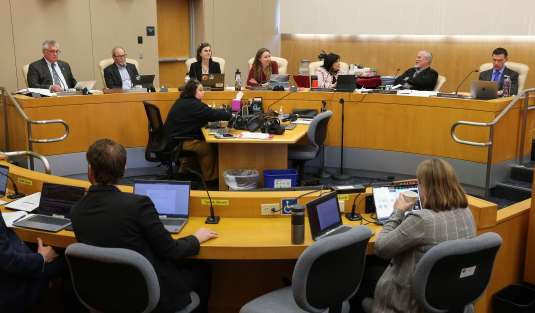
Christopher Chung/The Press Democrat
The Sonoma County Board of Supervisors meets in Santa Rosa on Tuesday, Jan. 28, 2025. (Christopher Chung/The Press Democrat)

By Emma Murphy | emma.murphy@pressdemocrat.com | The Press Democrat
PUBLISHED: December 9, 2025 at 5:13 PM PST | UPDATED: December 10, 2025 at 11:47 AM PST
In the brisk early hours Tuesday morning, Scott Orr, Sonoma County’s planning and permitting director, posted outside the main administrative building yellow and orange signs showing the distance of proposed setback requirements for commercial cannabis farms.
Land-use policy discussions don’t often include such displays, but the signs were another signal of the sharp debate that was expected to prevail Tuesday as the Board of Supervisors was set to adopt revised and controversial regulations governing the commercial cannabis industry outside city limits.
The ordinance overhaul marks the first significant change to the county’s regulations of commercial cannabis cultivation, sales and distribution since 2018.
The board voted 4 to 1 to adopt the new rules, which will take effect July 1.
The vote capped a fractious and labored process launched by the county in 2021 to amend its rules governing commercial cannabis and settle years of criticism from the local legal industry seeking relief from what they called a burdensome permitting process. Residents, as well, have been outspoken, seeking stronger safeguards against noise, odor and strain on limited water supplies.
Supervisor David Rabbitt, the lone “no” vote, criticized the ordinance as failing to adequately protect neighborhoods, including those in agricultural areas, from the impacts of outdoor cannabis cultivation.“I hope there’s enough money in the cannabis revenue fund to defend the upcoming lawsuit that’s inevitably going to happen,” Rabbitt said, referencing legal threats the county has already received regarding the rule changes.
Rabbitt also pushed back on his colleagues’ argument that the board can revisit the ordinance to address any future problems should they arise. That approach, he said, brings further complications and overloads county staff.
His comments were met with cheers and applause from a vocal audience, the majority made up of residents who opposed the revised rules. Several crowd members held up paper signs that read “Stop the Vote” on one side and “Face Recall” on the other.
The regulation changes include setback and acreage requirements, rules governing events at cannabis farms, a move to designate cannabis as controlled agriculture and the establishment of a new permitting pathway called “crop swaps.” The crop swap program would allow farmers to plant cannabis in place of previous crops so long as the operation uses the same amount of resources, including water, and does not require new infrastructure.
The regulations also brought new rules for cannabis distributors and retailers, but the main source of dispute has been the county’s regulation of outdoor cannabis farming.
There are 57 legal marijuana farms spanning a total 18 acres of cultivation in the county’s jurisdiction, according to inspection records. Additionally, there are seven retailers, five manufacturers and seven distributors in the county’s jurisdiction.
What’s in Sonoma County’s cannabis ordinance
The commercial cannabis regulations approved Tuesday include:
- Redefine cannabis as “controlled agriculture.” Cannabis is currently treated as an agricultural product but regulated separately; the new designation would carry its own standards.
- Allow cannabis events. Though previously prohibited, the new regulations would allow two different types of events: special events such as weddings where cannabis is incidental and cannabis events where cannabis is the focus. Both would require permits.
- Create a streamlined approval pathway for cannabis cultivation through a new program called “crop swaps.” The program would allow farmers to plant cannabis in place of previous crops so long as the cultivation uses the same amount of resources, including water, and does not require new infrastructure.
- Apply a 1,000-foot setback from the boundaries of residential zones and everything within residential zones, as well as from incorporated city boundaries. Outside residential zones, apply a 500-foot setback from neighboring residences and non-grazing, agricultural operations such as vegetable farming
- Apply the “Right to Farm” ordinance, which would shield compliant farms from nuisance complaints.
- Establish a minimum parcel size of 5 acres.
Critics of the ordinance include the Sonoma County Farm Bureau, Sonoma County League of Women Voters, the Sonoma Alliance for Vineyards and the Environment, and Neighborhood Coalition Sonoma County, a volunteer network of residents advocating for commercial cannabis cultivation to be limited to indoor industrial areas.
Their concerns run the gamut from whether the regulations safely protect water resources and air quality to whether cannabis should be treated similar to other agriculture. But zoning setbacks became the primary source of debate Tuesday.
The ordinance applies a 1,000-foot setback from the boundaries of residential zones and everything within residential zones, as well as from incorporated city boundaries. Outside residential zones, it would have established a 100-foot setback from the property line and a 300-foot setback from a dwelling, but residents in those zones urged supervisors to establish 1,000-foot setbacks across the board, even in agricultural zones.
“We’re just asking you to treat us all the same, the same 1,000 feet that you probably have,” Bill Krawetz, a Sebastopol resident, told the board.
While local cannabis producers have attended prior cannabis policy discussions en masse, Erich Pearson, CEO of SPARC, which has several dispensaries in Sonoma and Napa counties, was the lone such voice at Tuesday’s meeting. During public comment, he tied the wine industry and Farm Bureau’s interest in larger setbacks to state rules governing treatments that can be used on grapes versus on cannabis.
“The things they spray on grapes are not allowed on cannabis,” said Pearson, who is a Farm Bureau member.
The Farm Bureau did not have a representative address the board Tuesday. A Dec. 5 letter it sent to the board critical of the revised rules did not mention setbacks.
In interviews last week, Supervisors James Gore, Chris Coursey and Lynda Hopkins said they intended to stand by straw votes they took in October endorsing the 100-foot and 300-foot setbacks.
On Tuesday, the board majority, which also included Supervisor Rebecca Hermosillo, increased the setbacks to 500 feet from neighboring residences and non-grazing, agricultural operations such as vegetable farming — 200 feet more than originally proposed but less than the 1,000 feet sought by neighborhood interests.
The move did not satisfy coalition members. They were also left frustrated that the board did not add to the ordinance an option for neighborhoods to apply for exclusion-zone status, effectively blocking cannabis grows from within their neighborhood boundaries.
Hopkins, pushing back on the calls for exclusion zones, said the county’s program to create exclusion zones for vacation rentals was significantly flawed and had created inequities between wealthy communities that could afford to go through the process and those who lacked the resources.
She added that the regulations included in the ordinance created strong safeguards for communities.
“I believe we are setting forward a very protective ordinance,” Hopkins said.
As the board appeared poised to approve the new regulations, a few coalition members said they felt unheard by the board and shared their expectations that the Neighborhood Coalition would lead a recall effort.
Gore cast his vote via Zoom while traveling, citing a provision of California’s open meeting law he said allowed such participation. He then recused himself from part of the discussion and vote dealing with cannabis dispensary and manufacturer regulations after receiving campaign donations from related business owners.
You can reach Staff Writer Emma Murphy at 707-521-5228 or emma.murphy@pressdemocrat.com. On Twitter @MurphReports.